Samstag, 8. Dezember 2012

Peter Ilyich Tchaikovsky


Peter Ilyich Tchaikovsky - Пётр Ильи́ч Чайко́вский
The Russian Master
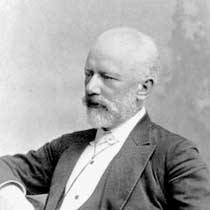
Peter Tchaikovsky
  • Peter Tchaikovsky was a Russian master composer of the Romantic Era. Tchaikovsky is nowadays one of the most beloved and famous composers of all time. His colorful music has enchanted listeners all over the world. His memorable melodies have ingrained themselves deep into popular culture.
  • His immense music talents had their source in an unhappy soul. Tchaikovsky suffered from depression and neuroses his whole life, and was extremely sensitive to criticism. He poured his unhappiness into writing passionate music.
  • Some of his most famous works are:
    “Symphony No 6”, (http://www.youtube.com/watch?v=yDqCIcsUtPI)
    “Swan Lake”,
    (http://www.youtube.com/watch?v=gP132E-xABg)
    “Violin concerto in D major”,
    (http://www.youtube.com/watch?v=GQAWJHITdhg)
    “Piano concerto no 1”,
    (http://www.youtube.com/watch?v=BWerj8FcprM)
    and his “1812 overture”
    (http://www.youtube.com/watch?v=VbxgYlcNxE8)

    which were all composed in the 1800's.
    You can still find his music recent movies like “V For Vendetta” (2006, Canada) or “The Concert” (2009, France).

Tchaikovsky's Rise to Greatness

  • Peter Tchaikovsky was born in 1840. He started learning piano when he was 5 years old, and got good quickly. His parents supported his musical talent at first, but then sent him to be a civil servant.
  • His mother died when he was 14. This tragedy deeply affected the young composer for the rest of his life. His mother's death was the inspiration for his composing - he wrote his first piece (a waltz for piano) in her memory.
  • He went on to study law and had a short career as a civil servant. But he hated it, so switched to studying at the St Petersburg Conservatory instead. After graduating, he became professor of music theory at the new Moscow Conservatory. He kept on composing during his professorship, and his reputation as a composer grew.
  • Other Russian musicians and composers shunned Tchaikovsky for a long time at the start of his career. They considered him a bit of an untrustworthy renegade since his music had a very western sound, and was more personally emotional than usual.
  • The Tsar noticed him eventually, gave him the Imperial stamp of approval and a lifetime pension, and suddenly Tchaikovsky was accepted in Russia.
  • He became even more famous, and traveled to other countries in Europe and the United States to conduct his own music. But although he was hugely successful, he was still under the black cloud of depression.
  • His sixth and last symphony (called the Pathétique) was premiered only ten days before the composer died (he died on November 6 1893).

Freitag, 19. Oktober 2012

Learning through listening

English is not my mother tongue. I learned English at school but I actually really improved by watching English movies. It must have been more than 200 movies I guess. That is about 300 hours of movie. My understanding of the language improved immensely by that. Listening to prepared audio samples in classroom context mostly doesn't reflect the actual language you would find when walking in the streets of that country. Movies are more authentic in that condition, and moreover it's more fun.
Having made this experience with the English language I want to start the same with Russian movies. Russian movies are not as easy to get as English movies. On DVDs you can change the language but in rare cases you'll find them in Russian. To start with some material I looked up Russian TV web pages on the internet.

On http://www.1tv.ru/ you can find previews to TV shows, documentations and the current news. Especially the news are interesting because it gives you insights in Russian current topics and daily live.   You'll also find international news e.g. on the Russian plane which was heading to Syria and got stopped by the Turkish aircraft. Every country's news has a different point of view - very interesting! 


                                                                  http://www.1tv.ru/

Dienstag, 2. Oktober 2012

Russian expansion history

I just read information on Russia on the CIA website. I was surprised how precise the information was they gave with the headers: Introduction, Geography, People Society, Government, Economy, Communications, Transportation, Military and Transnational Issues.

I always wondered why and since when Russia became that big. It says the Principality of Muscovy, which was founded in the 12th century, later emerged from the Mongol domination. From the 13th to 15th century it spread out and took over the sourrounding principalties (see picture below). Just in the 17th century under the expansion policy of the Romanov Dynasty the territories across Siberia to the Pacific were added. So the big expansion happened during the same time that the expansion of the USA to its current size.
In the 19th century the countries Ukraine, Belorussia, Uzebekia, Kazakstan, Georgia, Azerbaijan, Lithuania, Moldavia, Latvia, Kirghiztan, Tajikistan, Armenia, Turkmenia and Estonia had been part of the UdSSR. In today's Russian territory 85% of the population lives on the European part and only 23% in the Russian part.


https://www.cia.gov/library/publications/the-world-factbook/geos/rs.html
http://en.wikipedia.org/wiki/Russia

Montag, 10. September 2012

Stupid politics


My best friend Waldemar (Vladimir) is half German, half Russian but grew up in Russia. In our semester break 2010 we wanted to travel to St. Petersburg in Russia (not Florida). Travelling in the European Union is easy nowadays. You don't need a visa or any kind of permission to enter another country. We thought it would be the same when travelling to Russia. As we found out some weeks before leaving, the Russian government set restrictions on Germans to get a visa. That meant it would have been a lot of paperwork and it would have taken more than one month to get it. We didn't have that much time unfortunately. We were wondering why they would do that and as we found out, a few months before that time the German government had set restrictions on Russians to enter Germany. The Russian government responded by doing the same.
For me this is just stupid and childish and it spoiled our plans to go to St. Petersburg :-(
My lesson after that: Better check immigration policies and procedures way ahead before going to another country!